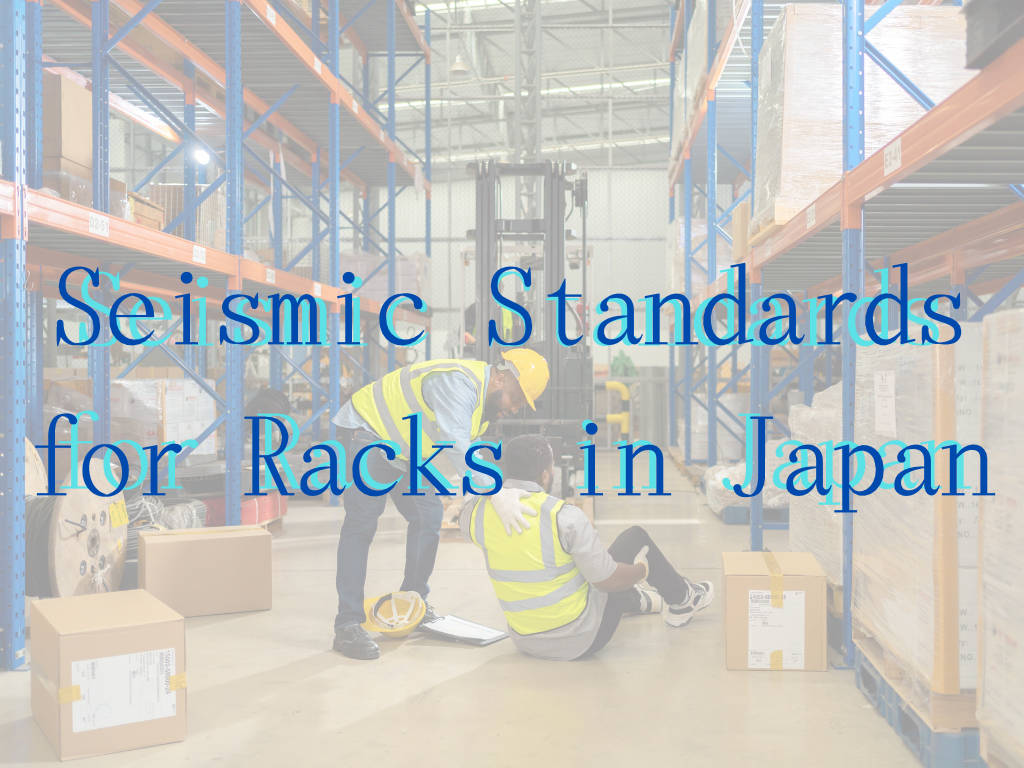
Japan experiences frequent earthquakes, making seismic safety an important consideration when selecting and installing warehouse racks.
During strong seismic motion, improperly designed, installed, loaded, or maintained racks may deform or overturn, while stored goods may shift or fall. These risks can lead to employee injuries, product damage, blocked evacuation routes, and extended warehouse downtime.
For companies establishing warehouses or logistics operations in Japan, seismic safety therefore needs to be considered as part of the overall rack design—not simply as an optional accessory.
This article explains the key points to consider when selecting earthquake-resistant warehouse racks in Japan, including applicable standards, seismic design, anchoring, load conditions, and ongoing inspections.
ー目次ー
One common misunderstanding is that Japan has a single JIS seismic standard that applies uniformly to every type of warehouse rack.
In practice, the situation is more complex.
JIS stands for Japanese Industrial Standards, Japan’s national industrial standardization framework. The specific standards and engineering criteria that should be considered depend on the rack type, structure, intended use, manufacturer specifications, and installation conditions.
For this reason, warehouse operators should not determine seismic safety simply by asking whether a rack is “JIS compliant.”
Instead, seismic planning should consider factors such as:
The appropriate seismic design should be determined based on the actual warehouse and storage conditions.
During an earthquake, racks are subjected to horizontal forces in addition to their normal vertical loads.
Tall racks and racks carrying heavy loads can be particularly affected by lateral movement. The way goods are distributed vertically also influences the behavior of the rack.
Seismic design therefore needs to consider the rack, stored goods, bracing, connections, anchors, and floor conditions as a complete system.
Rack stability is only one part of warehouse earthquake safety.
Even if the rack itself remains standing, pallets, containers, cartons, or individual products may shift or fall during strong shaking.
Depending on the stored goods and warehouse operation, additional measures may therefore be considered, such as:
The appropriate solution depends on the type of goods and how they are handled.
A rack-related incident can affect more than the immediate storage area.
Fallen products or damaged rack components may obstruct aisles and emergency routes, making evacuation and post-earthquake response more difficult.
For this reason, rack layout should also be planned in relation to worker routes, forklift aisles, exits, and evacuation paths.
The horizontal seismic coefficient is one engineering concept used to represent horizontal seismic forces in certain seismic design methods.
However, it should not be treated as a universal pass-or-fail number for all warehouse racks.
The appropriate design conditions depend on the equipment, structural system, installation environment, and applicable design criteria. Even official Japanese engineering specifications use different seismic coefficients depending on equipment categories, installation locations, and seismic performance classifications rather than one universal value.
Therefore, statements such as:
“Every rack in Japan must have a horizontal seismic coefficient of 0.2.”
or
“A coefficient of 0.2 means the rack can withstand JMA seismic intensity 5-lower.”
should not be used as universal rules.
A seismic coefficient and the Japan Meteorological Agency seismic intensity scale describe different concepts and cannot simply be converted from one to the other.
For an actual warehouse project, the required seismic performance should be confirmed through the applicable engineering criteria and rack design calculations.
Even a properly specified rack may not provide the intended performance if it is installed incorrectly.
One particularly important element is the connection between the rack and the floor.
Anchor selection and installation should take into account factors such as:
Simply adding more anchors does not automatically make a rack safer. The rack structure, base plates, anchors, and supporting floor must be considered together.
A common mistake when planning warehouse racks is to focus only on the rack’s rated capacity.
For seismic planning, the actual storage conditions are equally important.
Before selecting a rack, confirm:
The same rack may behave differently depending on the weight, height, and distribution of the stored goods.
This is why rack selection should begin with an analysis of the actual load and warehouse operation, rather than selecting a standard rack first and adapting the operation afterward.
No rack should be described as completely “earthquake-proof.”
The purpose of seismic design is to reduce foreseeable risks and achieve an appropriate level of structural performance under defined design conditions.
Depending on the facility and equipment, seismic planning may aim to:
Earthquake-resistant design should therefore be understood as part of a broader warehouse safety strategy rather than a guarantee that no damage will occur.
Seismic safety does not end when the racks are installed.
Warehouse racks can be damaged during everyday operations, particularly through forklift impacts.
Even relatively small deformation to an upright, beam, brace, or connection can affect the condition of the rack.
Regular inspections should therefore check for:
Racks should also be inspected after a significant earthquake before normal operations resume.
If damage is found, the affected rack should be assessed appropriately rather than continuing to use it without confirmation.
When planning a new warehouse or replacing existing racks in Japan, seismic performance should be evaluated together with storage capacity and operational efficiency.
Important questions include:
For overseas companies opening a warehouse, factory, or distribution center in Japan, it can be difficult to determine which rack specifications are appropriate.
Specifications that have been used successfully in another country should not automatically be applied to a Japanese facility without reviewing local conditions.
Warehouse planning should consider not only seismic requirements but also:
The most effective approach is to evaluate these requirements together rather than treating rack procurement as an isolated purchase.
Logical Company supports warehouse rack projects based on the conditions of each facility, from equipment selection and layout planning to installation.
Rather than applying a single specification to every warehouse, we review factors such as rack type, stored goods, load conditions, installation environment, floor conditions, material-handling methods, and required safety measures before proposing an appropriate solution.
For companies entering the Japanese market, this can also simplify the process of coordinating warehouse equipment with local operational requirements.
Earthquake safety is an important consideration when installing warehouse racks in Japan, but there is no single seismic specification that can be applied blindly to every rack and every facility.
Effective seismic planning requires a comprehensive review of rack structure, stored loads, anchoring, floor conditions, fall-prevention measures, layout, and maintenance procedures.
It is also important to distinguish between JIS standards, engineering design criteria, manufacturer specifications, and facility-specific requirements rather than assuming that one numerical seismic coefficient guarantees safety.
Logical Company can support rack selection, layout planning, installation, and seismic safety considerations for warehouses and factories in Japan.
If you are planning to install pallet racks, storage racks, or other warehouse equipment in Japan and need guidance on seismic design and safe installation, please contact Logical Company for a facility-specific consultation.
保管ラック
特殊ラック
保管ラック
特殊ラック

関連ワード
今回も最後までお読みいただきありがとうございます。
このコラムを読んだ方は次の記事も合わせて読むと、さらに御社の倉庫や工場のレベルアップに繋がると思います。ぜひご覧ください!
2026.08.25
保管ラック 特殊ラック 2026.08.07
保管ラック 特殊ラック 2026.08.25
倉庫の設備のことなら
東京ロジカルにお任せください!
お電話 :  03-6658-4419

 CONTACT
 ポスト
ポスト シェアする
シェアする